DCS/PLC templates
A template tells BHTune how one DCS/PLC vendor's PID controller block expresses itself
over OPC DA: what the proportional/integral/derivative terms are called and what units
they're in, what suffix each related tag uses, and what raw values a mode tag holds for
Manual/Auto. Selecting a template is what lets bhtune tune turn a single process-variable
tag into a complete, correct tag set for a given control system.
BHTune ships four templates out of the box (Yokogawa CentumVP, Honeywell Experion, Schneider Modicon, Allen-Bradley PlantPAx), and templates are an ordinary, contributable data file — adding support for another DCS/PLC family is a pull request against a TOML file, not a Rust change. Contributions of new templates are very welcome. The goal is a community-maintained library that eventually covers as many control systems as possible; see Contributing a template below.
Where templates come from
A template row in BHTune's database has one of three origins:
| Origin | Source | Re-seeded on every startup? |
|---|---|---|
builtin | The catalog embedded in the bhtune binary itself (crates/bhtune-core/templates/builtin.toml) | Yes |
catalog | Your own catalog file, auto-loaded on startup (--templates/BHTUNE_TEMPLATES, see the README's Configuration table) | Yes |
user | Hand-imported (bhtune template import) or otherwise created | No |
builtin and catalog rows are re-applied from their source file every time bhtune
starts, so editing the file is how you change them; user rows are left alone. This is why
there's no way to permanently delete a builtin/catalog template with bhtune template delete alone — it comes back on the next start unless you also remove it from the file
that seeds it.
The TOML catalog format
Both the embedded catalog and your own catalog file use the same shape: a TOML array of
tables, one [[template]] block per template.
[[template]]
name = "Yokogawa CentumVP"
revert_mode = true
proportional_type = "band"
integral_type = "reset_time"
integral_unit = "seconds"
derivative_type = "derivative_time"
derivative_unit = "seconds"
process_variable_suffix = "PV"
manipulated_variable_suffix = "MV"
setpoint_variable_suffix = "SV"
controller_direction_suffix = "DR"
controller_mode_suffix = "MODE"
mode_attribute_suffix = ""
upper_pv_range_suffix = "SH"
lower_pv_range_suffix = "SL"
upper_mv_range_suffix = "MSH"
lower_mv_range_suffix = "MSL"
proportional_constant_suffix = "P"
integral_constant_suffix = "I"
derivative_constant_suffix = "D"
mode_manual_value = "MAN"
mode_auto_value = "AUT"
controller_action_direct_value = "0"
versions = ["R5", "R6"]
description = "Yokogawa CENTUM VP DCS: PID station function block, proportional-band convention, MAN/AUT mode tag."
source = "Field-confirmed tag mapping from a live CENTUM VP deployment."
This is the actual built-in Yokogawa CentumVP template, used as the running example for every field below.
Field reference
The prose below documents each field's meaning; the same shape is also expressed as a
machine-checked JSON Schema, generated straight from the DcsTemplate Rust type, at
docs/reference/config.md — useful for validating a catalog file or
generating an editor with autocomplete, and guaranteed to never drift from what
bhtune template import actually accepts.
Identity
| Field | Type | Meaning |
|---|---|---|
name | string, required | The unique key. bhtune template show/export/delete all look a template up by this. Two templates covering different releases of the same vendor get different names (e.g. "Yokogawa CentumVP" vs. a future "Yokogawa CentumVP R7"), not the same name edited in place — see Versions. |
versions | array of strings, optional | The DCS/PLC releases this mapping is known to apply to, in that vendor's own version-naming convention ("R6", "Unity Pro V8.1", "4.0" — whatever an engineer at that system would actually recognize). May be empty if you don't know. Not an exhaustively tested compatibility matrix — see below. |
description | string, optional | A short free-text summary of the control system and PID convention this template targets. |
source | string, optional | A citation for where the mapping came from — a manual, a reference document, a field deployment. Provenance, not a correctness guarantee (see below). |
PID convention
| Field | Type | Values | Meaning |
|---|---|---|---|
proportional_type | enum | "gain" (Kp, dimensionless) or "band" (PB%, PB = 100 / Kp) | How this DCS expresses the proportional term. |
integral_type | enum | "reset_time" (Ti), "reset_rate" (Ri, Ri = 1 / Ti), or "reset_gain" (Ki, Ki = Kp / Ti) | How this DCS expresses the integral term. |
integral_unit | enum | "seconds" or "minutes" | The time unit integral_type is expressed in, when it's time-based. |
derivative_type | enum | "derivative_time" (Td) or "derivative_gain" (Kd, Kd = Kp * Td) | How this DCS expresses the derivative term. |
derivative_unit | enum | "seconds" or "minutes" | The time unit derivative_type is expressed in. |
revert_mode | boolean | — | Whether the loop's controller mode is switched back to its original mode (e.g. Auto/Cascade) after a completed test. Has no effect if the loop was already in Manual when the test started. |
Tag suffixes
BHTune derives a loop's full tag set from a single process-variable (PV) tag plus these
suffixes: it replaces everything after the last ., !, or / in the PV tag's path with
each suffix in turn. For a PV tag of Unit1.LIC101.PV, the Yokogawa template above derives
the manipulated-variable tag as Unit1.LIC101.MV, the setpoint tag as Unit1.LIC101.SV, and
so on for every non-empty suffix field. Slash-separated namespaces such as
FCS0201/Control/PV preserve their slash separator when deriving FCS0201/Control/MV.
The same rule is used when an engineer selects a tag in the web UI. For example, browsing
Area01.FIC101.OUT with a template whose process_variable_suffix is PV produces
Area01.FIC101.PV. BHTune first reads Area01.FIC101.OUT to check its OPC quality, then
replaces the final component; it does not blindly append .PV. The preceding path and its
final separator are preserved.
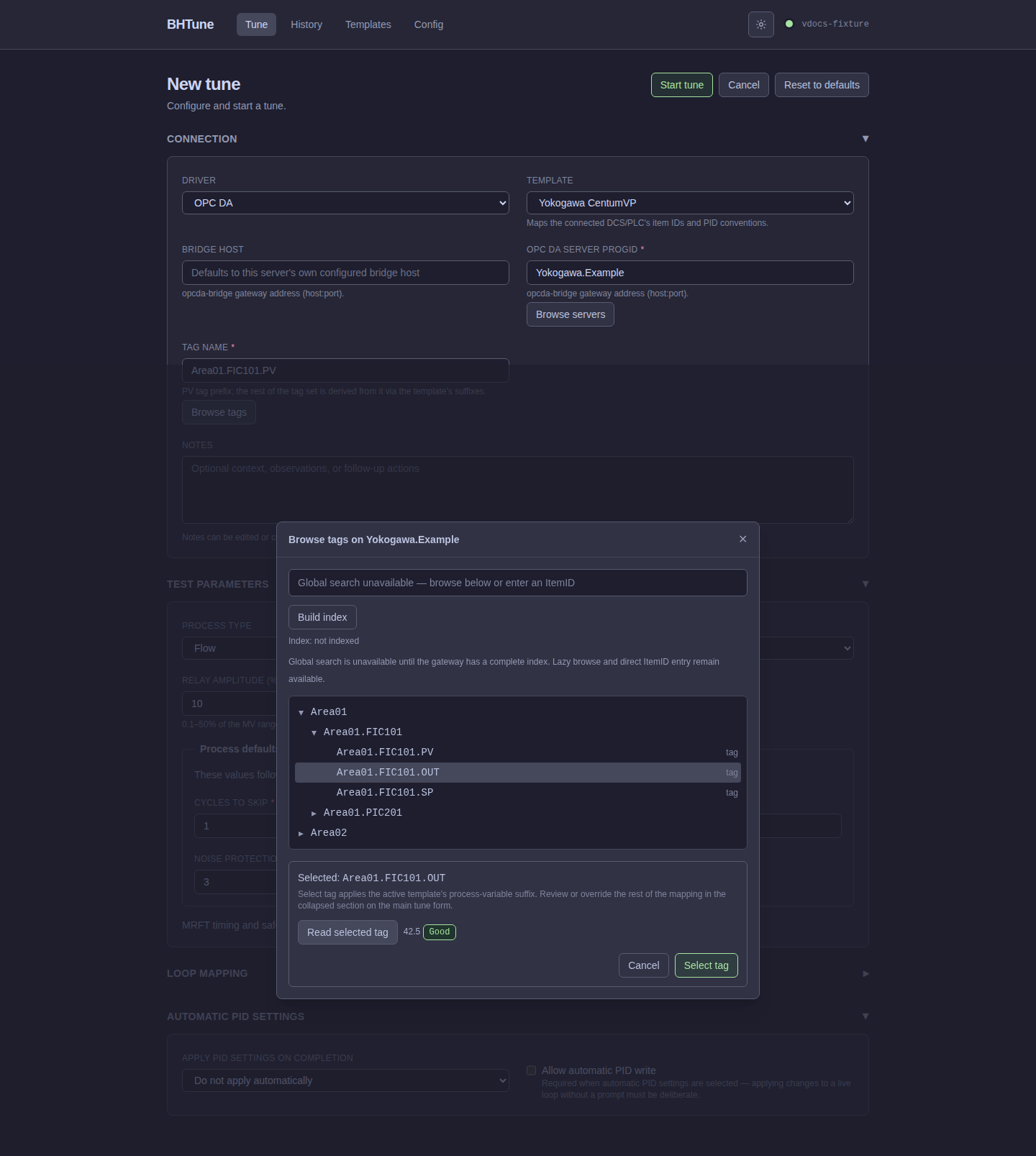
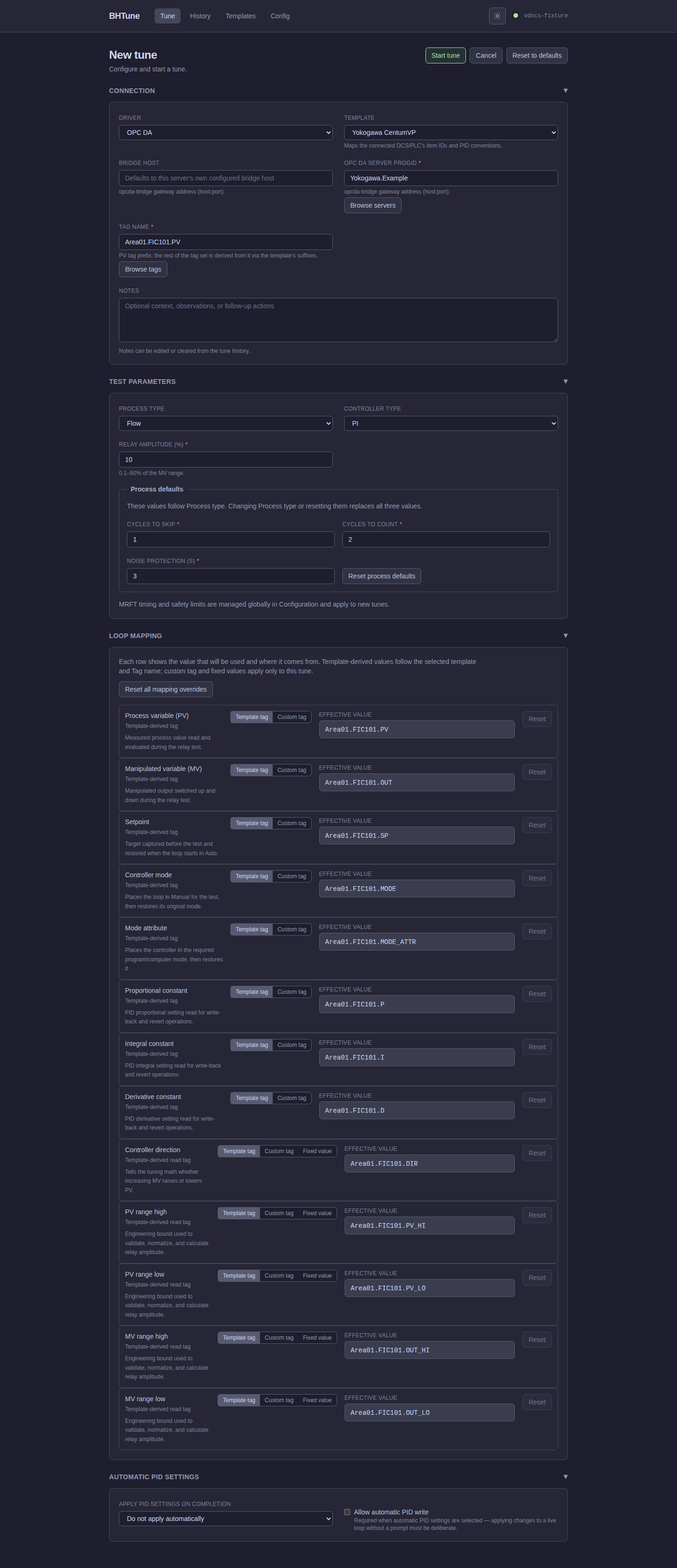
OUT item to the active template's PV item while preserving the path.| Field | Meaning |
|---|---|
process_variable_suffix | The PV tag's own suffix — required. |
manipulated_variable_suffix | The controller output/MV tag — required. |
setpoint_variable_suffix | The setpoint tag. |
controller_direction_suffix | The tag holding Direct/Reverse controller action. |
controller_mode_suffix | The tag holding the controller's Manual/Auto mode. |
mode_attribute_suffix | A second mode-related tag some DCS families require to permit external OPC writes (e.g. Honeywell Experion's MODEATTR, which must read "Program" first). |
upper_pv_range_suffix / lower_pv_range_suffix | The PV's engineering-unit range. |
upper_mv_range_suffix / lower_mv_range_suffix | The MV's engineering-unit range. |
proportional_constant_suffix / integral_constant_suffix / derivative_constant_suffix | The tags the calculated P/I/D constants are written back to. |
An empty string ("") means "this DCS has no such concept" — for example, Yokogawa
CentumVP has no separate mode-attribute tag, so mode_attribute_suffix = "". This is
different from leaving a field out entirely, which isn't valid for suffix fields (they're
all required strings, just possibly empty).
Raw tag values
| Field | Meaning |
|---|---|
mode_manual_value / mode_auto_value | The literal raw value controller_mode_suffix's tag holds for Manual and Auto, respectively (e.g. Yokogawa uses the literal text "MAN"/"AUT"; Schneider Modicon uses the literal text "false"/"true"). Required whenever controller_mode_suffix is non-empty. |
mode_attribute_program_value | The raw value mode_attribute_suffix's tag must hold for OPC writes to be accepted (e.g. Honeywell Experion's "2" for Program). Required whenever mode_attribute_suffix is non-empty; otherwise omit it. |
controller_action_direct_value | The raw value controller_direction_suffix's tag holds when the controller is Direct-acting (every built-in template uses the literal text "0", but this is vendor-specific, not assumed). |
All of these are strings, even when they look like booleans or numbers ("false",
"true", "0"). This matters: unquoted false/true/0 in TOML are boolean/integer
values, not the strings BHTune's schema expects, and would fail validation or silently
mean something different. Always quote them.
Validation
Every template — built-in, from your catalog file, or hand-imported — is validated before it can be used:
namemust be non-empty (after trimming whitespace).process_variable_suffixandmanipulated_variable_suffixmust both be non-empty — without them, no tag set can be derived at all.- If
controller_mode_suffixis set, bothmode_manual_valueandmode_auto_valuemust be non-empty. - If
mode_attribute_suffixis set,mode_attribute_program_valuemust be present.
A template that fails validation is rejected outright — at catalog-parse time for the
embedded/user catalog, and at bhtune template import time for a single-template JSON
file — rather than being accepted and only failing later, mid-tune, against a live loop.
Versions, not a "verified" flag
versions records the releases a mapping is known to apply to, framed as "current when
this mapping was authored," not as an exhaustively tested compatibility matrix. When a
newer release of a DCS/PLC changes its tag conventions, add a new [[template]] entry
with its own name and versions list — never edit an existing entry's suffixes in place.
Sites still running the older release depend on the mapping exactly as it's already
written; changing it out from under them is a silent regression for someone else.
There is deliberately no separate "verified" trust field. Everything accepted into the catalog is treated as verified, and genuine mapping errors are fixed as bugs when they surface — a three-state trust badge would need someone to adjudicate and maintain it per template, and a stale or wrong badge is worse than no badge at all.
Contributing a template
- Start from an existing
[[template]]block incrates/bhtune-core/templates/builtin.tomlclosest to your control system, or export a template you've already built via the CLI (see below) as a starting point. - Fill in every suffix field for your DCS/PLC's PID block, its raw mode values, and a
versionsentry naming the release(s) you tested against. - Add a short
descriptionand asourceciting where the mapping came from (a manual, a function block reference, a field deployment). - Open a pull request against
builtin.toml. CI parses and validates the whole file on every push, so a malformed or incomplete contribution fails the build rather than merging silently broken. - If you'd rather keep a template private to your own site instead of (or before)
contributing it upstream, put it in your own catalog file instead — see the README's
Configuration table for the
--templates/BHTUNE_TEMPLATESauto-loaded catalog path.
See CONTRIBUTING.md
for the repository's general contribution workflow (branching, commit style, the CLA).
CLI usage
# List every template (built-in, catalog, and user-imported)
bhtune template list

# Show one template's full field detail as JSON
bhtune template show "Yokogawa CentumVP"

# Export a template as a starting point -- JSON for a single-template copy,
# or TOML for a catalog-ready, PR-able [[template]] block
bhtune template export "Yokogawa CentumVP" ./my-template.json
bhtune template export "Yokogawa CentumVP" ./my-template.toml --format toml

# Import a template -- a single JSON template, or a multi-template TOML catalog
# (auto-detected from the file's content, not its extension)
bhtune template import ./my-template.json
bhtune template import ./site-catalog.toml

# Delete a template (refuses if a saved loop still references it)
bhtune template delete "My Custom Template"