Starting a tune
The New Tune page at /runs/new combines connection, tag mapping, test parameters,
simulator settings, notes, and optional automatic PID write-back. The server validates the
request again when the run starts; the form's disabled states and validation messages are
convenience, not a safety boundary.
Simulator form
Choose Simulator when learning the workflow or checking a template's PID-unit conversion without a plant connection. The form keeps the same layout but disables the OPC server, bridge, tag, quality, timeout, and automatic write-back controls because the in-process simulator cannot use them. The template remains enabled because it still controls the result convention shown after the run.
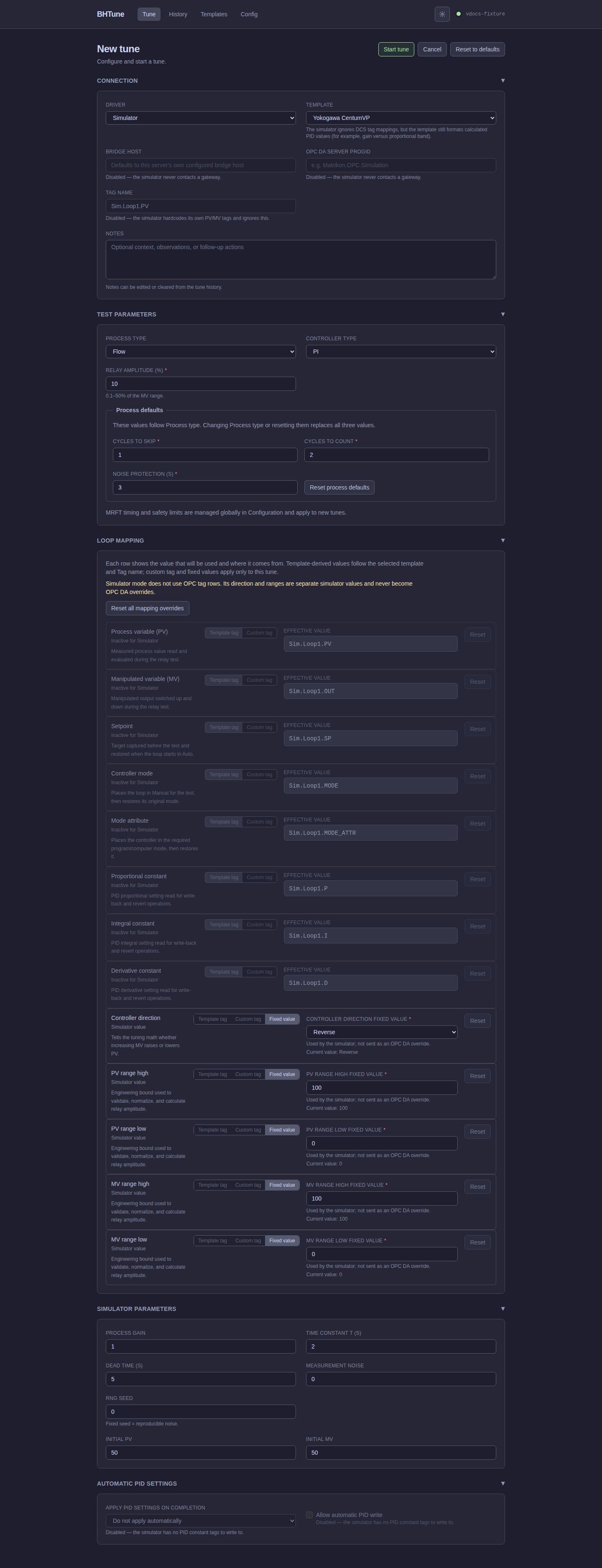
The Test parameters section shows process-type defaults for cycles to skip, cycles to count, and noise protection. Changing process type replaces those three values; Reset process defaults restores them without changing unrelated tune settings. Installation-wide MRFT delay, poll interval, operation timeout, whole-run timeout, and restore timeout are managed on the Configuration page.
OPC DA connection and mapping
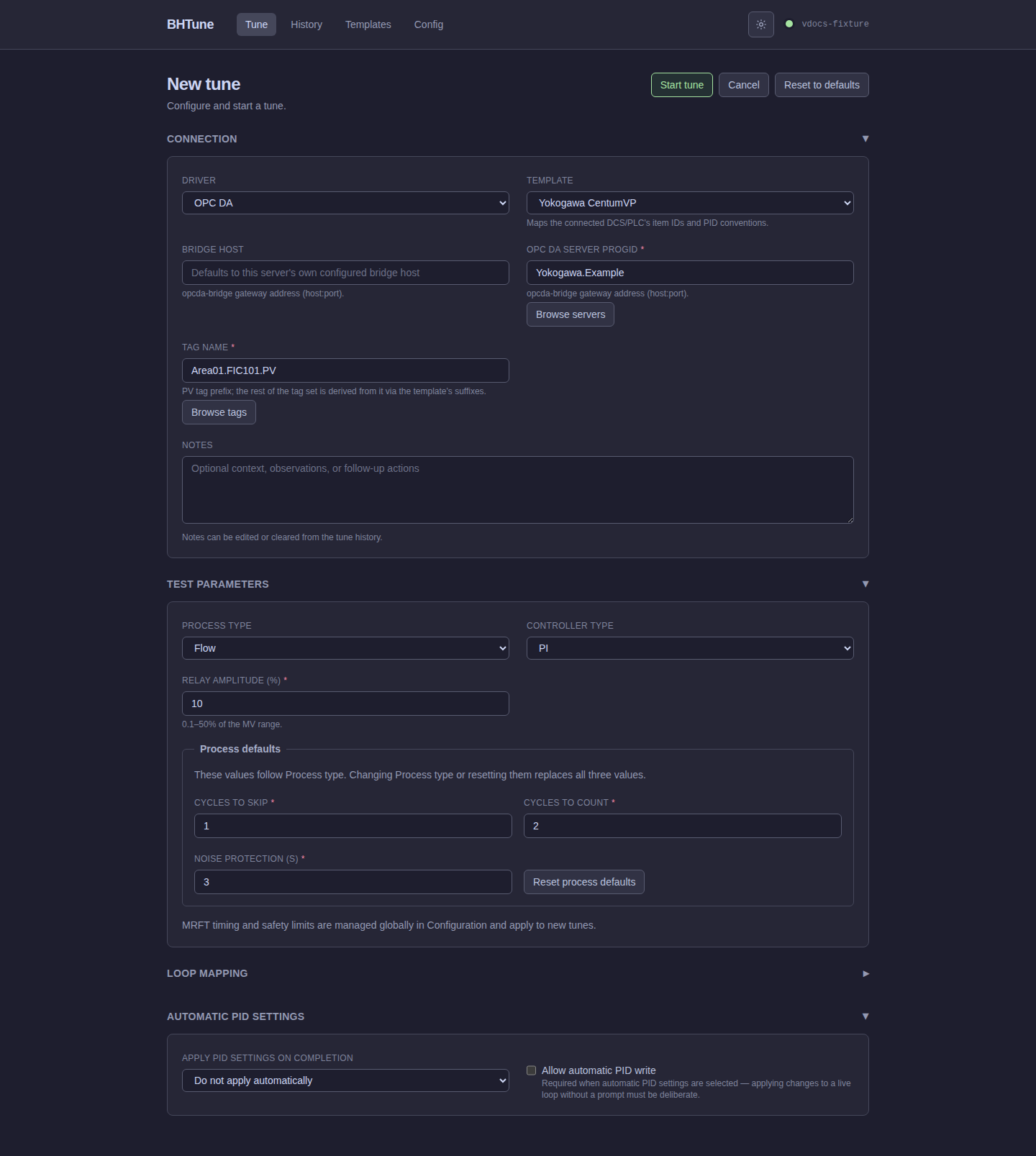
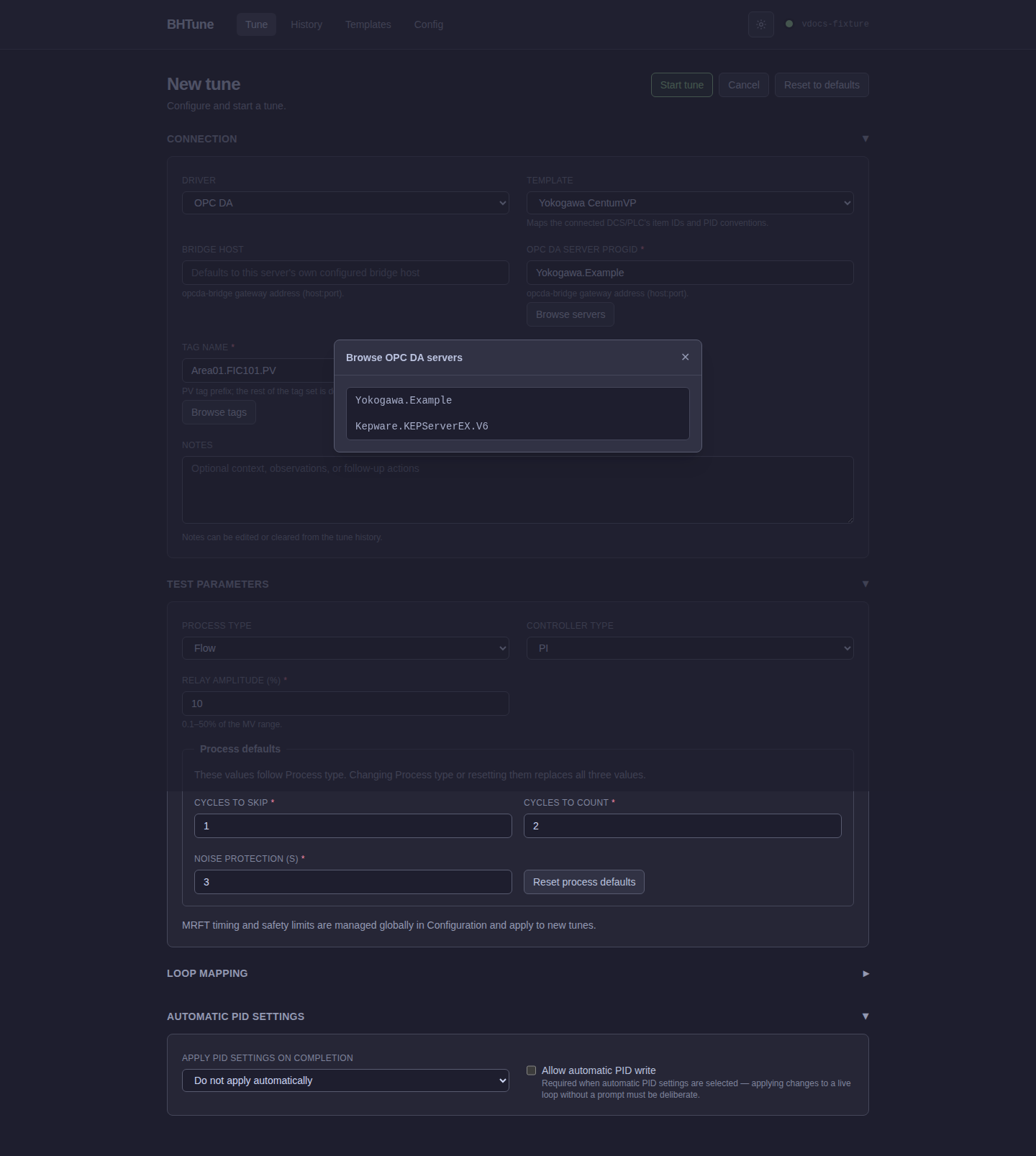
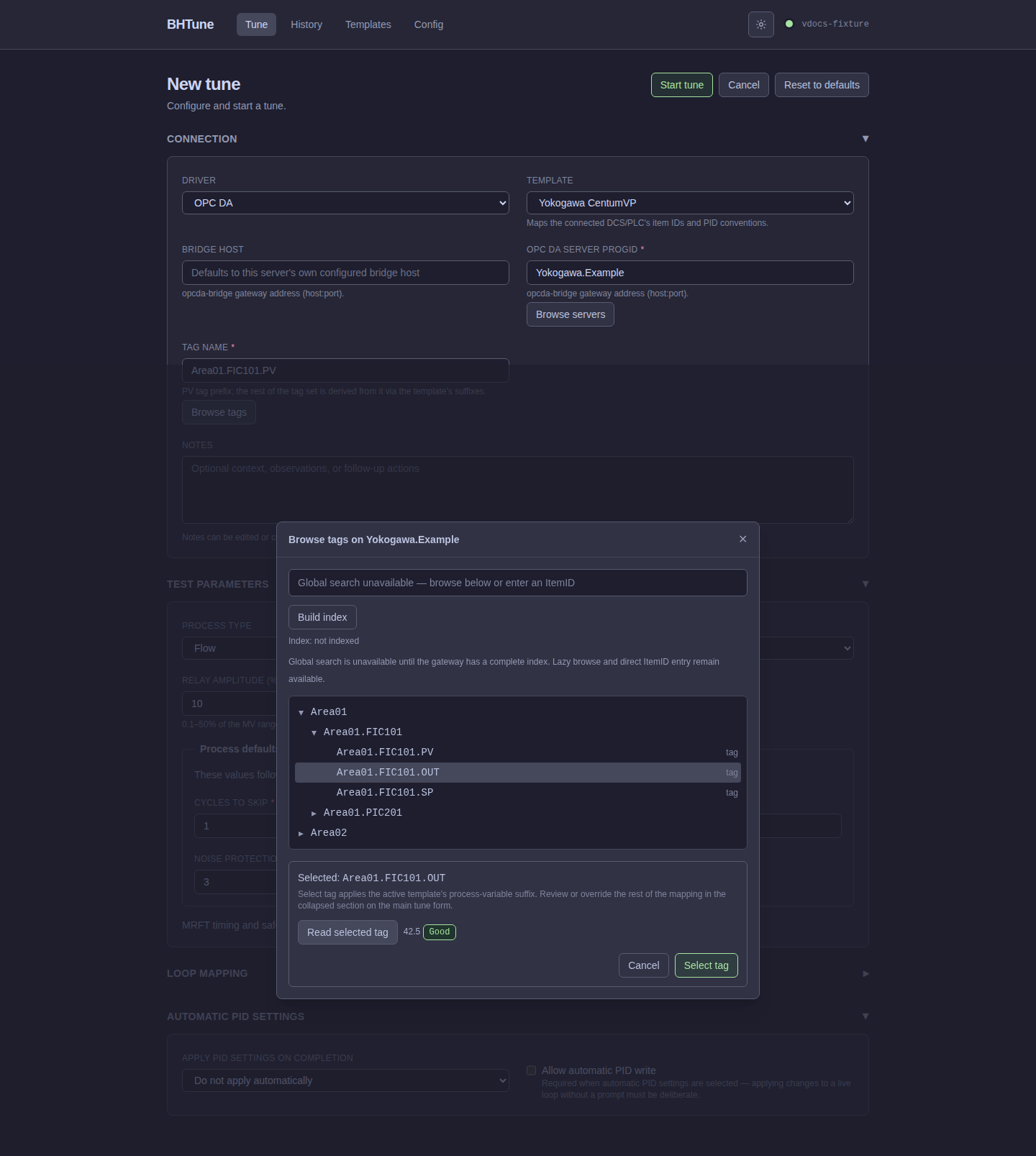
Choose OPC DA to expose the Bridge host, OPC DA server ProgID, Tag name, and Notes fields. Browse servers discovers registered ProgIDs on the configured gateway. Browse tags opens a one-level-at-a-time tree after a ProgID is present. The browser can expand dotted or slash-separated namespaces, test-read a selected item, and preserve the current path when reopened.
Template suffix replacement
Selecting any browsed item does not blindly append .PV. BHTune reads the original item first
for OPC quality verification, then replaces everything after the final ., !, or / with
the active template's process_variable_suffix, preserving the preceding path and separator.
For example, with a template whose process-variable suffix is PV:
Browsed item:  Area01.FIC101.OUT
Tag name:      Area01.FIC101.PV
This is final-component replacement, not string concatenation. The same separator-aware rule
means FCS0201/Control/OUT becomes FCS0201/Control/PV, and a tag with a ! separator keeps
that separator. The backend applies the same derivation when the run starts, so the preview is
not a second source of truth.
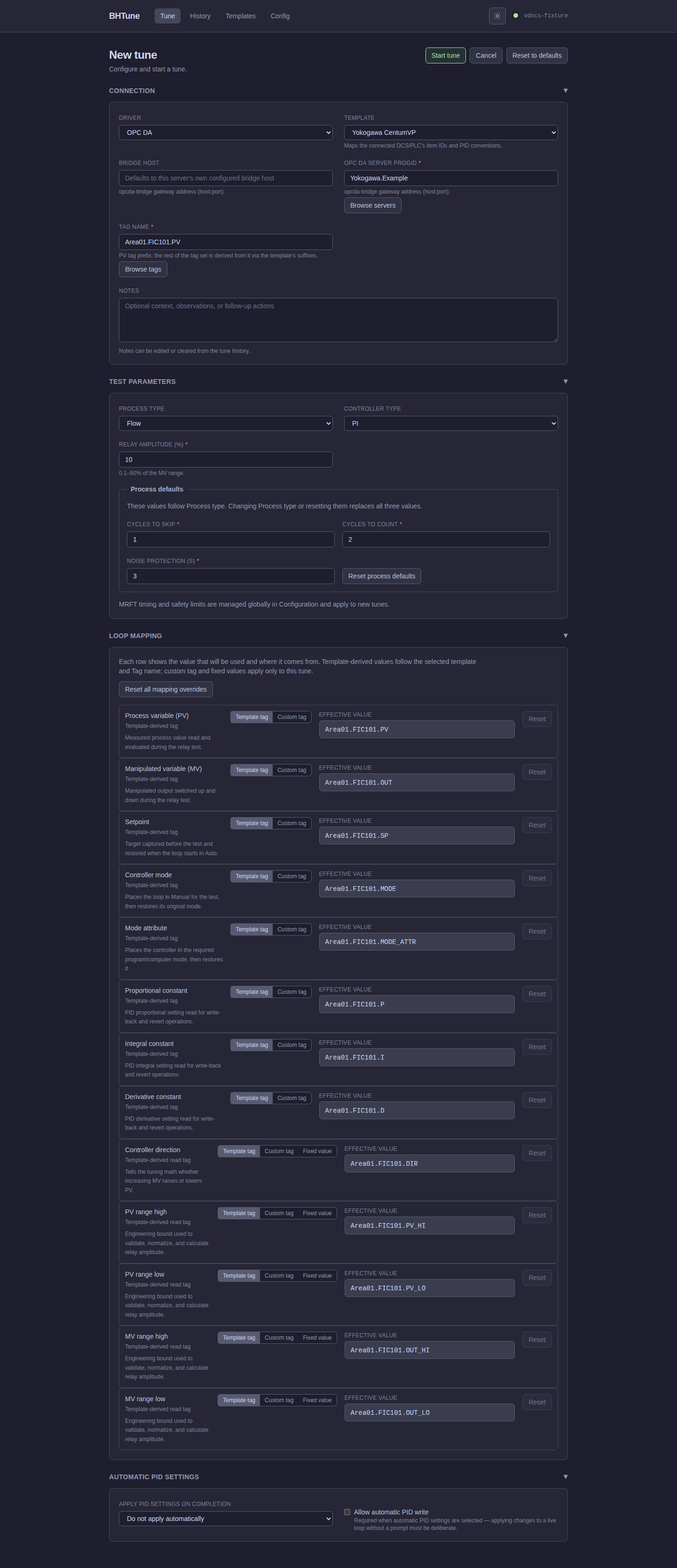
The Loop mapping section is the single place to inspect the effective tag set. Tag rows use Template tag or Custom tag sources. Direction and range rows additionally support Fixed value. Changing the base Tag name or template resets Custom tag sources and preserves Fixed value choices. Use a row's Reset or Reset all mapping overrides action to return to template-derived values.
The browser's Read selected tag action displays value and quality. Good quality proceeds
immediately. Uncertain or Bad quality requires an explicit choice to select another item or
continue; starting a tune still applies the server's normal quality safeguards.
Drafts, notes, and automatic PID writes
Every editable field except Notes is saved as the app-wide New Tune draft, including values belonging to the inactive driver. Notes intentionally start blank after reload so operator context is not copied into another tune. Duplicate this run takes precedence over the saved draft and newest-run fallback; Reset to defaults replaces the draft with built-in defaults.
Notes are optional run metadata and can be edited or cleared from run detail. Automatic PID write-back is available only for an eligible OPC DA run and requires explicit confirmation; reviewing or writing calculated results after completion is documented in Runs and history.